
I was originally going to make this post about villains. I even threw a Google search or two at the topic and found out that there are a good number of places that are straight up named villain-this-or-that (Villains Vintage Clothing, not too far from me, and Villains Tavern in LA). But the spark just wasn’t there. The villains post will happen…some day.
So, instead I want to write about vignettes or episodes, by which I mean to reference those little bits of plot that may begin and end within 1 to 3 chapters. A good example of this would the mines of Moria episode in the Lord of the Rings. The characters in that portion of the book enter in to a sort of time capsule amidst the fallen ruins of a dwarven kingdom.
While there is an overall attachment to the rest of the story, that attachment is tenuous at best, but the very fact that it is remote, contained, and possibly irrelevant is what allows the episode to break the banality of a linear plot progression. Whether it’s Harry Potter fighting a troll, Luke Skywalker ingratiating himself to a group of e-woks, or Katniss Everdeen fighting off a gaggle of tracker jackers, these help to disrupt the plot and keep everyone involved interested (note that I did not restrict this to “readers” as I think authors can be just as bored by an A to B plot progression).
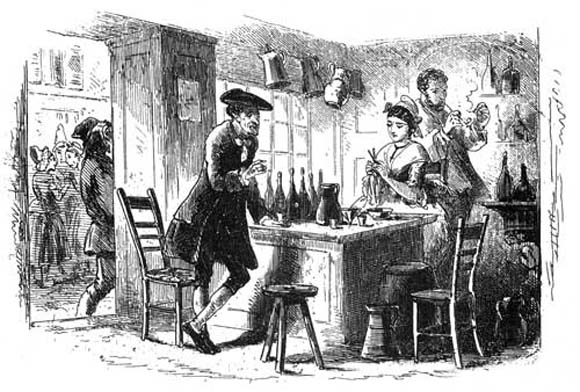
Dickens’ Wine Shop
So the question then is: how does one go about designing a good vignette? Well, first think about your setting. The vignette should have an identity within your universe and help reinforce how this universe is conveyed. For instance, in the e-wok example above, we can see a few ways that this links into the feeling of a very alien universe where even the teddy bears can be deadly. In a Dickensian setting, the vignette will form around a rag and bottle shop or the like to convey how truly grey and sooty the Victorian cities were at that time; or there may be an episode about a man who runs a pawn shop for human limbs to show how ridiculous the setting is.
The second piece is deciding whether the vignette will be a scene in the life of an existing character or a scene created/populated around one or more confined characters. The advantage of the former is that you can flesh out one of your characters by showing (for example) that he or she is a hoarder, has a secret cosplay hobby, or simply loves skydiving in a flying squirrel suit. The vignette for that character can also be a good tool for foreshadowing or metaphor (eg items in the hoard pile can serve as clues to a later mystery or the skydiving may be a prelude to a character’s abrupt fall within society).
On the other hand, the advantage of creating new characters for your vignette is that you can make them as ridiculous as you like without feeling like you need to do upkeep. They also give you back-pocket characters that you can bring up when least expected. In example, we have Sirius Black, who seemingly disappears after the end of the third Potter book, only to make appearances later on down the line. Dickens I really find myself letting go when I create these one-off characters, giving them strange accents, hobbling insanity, peculiar outfits, etc.
However you position your vignette, remember that the most important thing is to keep everyone engaged. You can write the most technically-superb book or movie, but that won’t matter if the audience falls asleep during the first act.

 The Rewritten Word