Incomplete Book Review: Cinnamon Roll Murder

In this incomplete book review series, I will review only an Amazon sample portion or the first fifteen pages of a book. The first section will be a completely honest and unbiased review of these introductory pages. In the second section I will wildly speculate about how the plot progresses.

Incomplete Book Review of the Cinnamon Roll Murder

(In which we find out no cinnamon rolls were actually injured in the production of this book)

The intro to the Cinnamon Roll Murder follows the epic journey of Hannah Swensen as she careens down the Minnesota highway at a screaming 40 mph in her cookie mobile on her way to see a band called Ciuntitlednnamon-something. It’s never clear what drugs she has ingested that would convince her that any of this is acceptable behavior, and soon it becomes apparent that her destiny is to narrowly avoid a dozen-car pileup caused by some reckless out-of-staters who clearly do not comprehend the metaphysical stasis that has reduced Minnesota’s seasons into the snow season, the mud season, and two others that are too similar to remember. We are constantly reminded that this is cow country, eg with clever references to KCOW, the only radio station moniker that makes any sense in a world so cold and brutal as the MN.
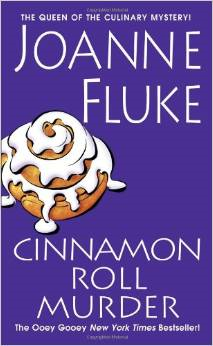
Soon Swensen pulls a Tom Cruise and lethargically joins the scene of the accident, ripping open bus doors with all the gusto of an arthritic He-man. But what happens next and why? You’re guess is as good as mine as this reviewer became psychically snow blind halfway through the read…

The rest of this review was put together from the mad ramblings written down on cheap a Kleenex that I found beneath the store bookshelf. This may or may not represent what actually happens next and a plausible opinion about it:

The band’s bus had overturned pretty badly. It was like three different realities intersected at once and then we were tossed into the white one. Hanna Swensen’s disembodied head rolled down the aisle. She was somehow able to stay alive through the use of teleportation…but this might not be wholly accurate.

Here it must be noted that the author Joanne Fluke arduously captures the bitter disappointment that living in Minnesota must impart, and this bus accident is the pinnacle of malaise. Nobody seems to care that there is this big box of bloody bodies and certainly Hannah has time to stop and make small chat in between. You have to think that both she and her compatriot Michelle have been trapped in the land of cows for so long that indifference has become a way of life.

Fluke knows how to hide the ball: the bus driver’s demise is either the result of a chemical journey of the mind or sudden impact, though the difference between the two can sometimes be so subtle as to require the application of methodological skepticism to discern. There’s a puppy involved somewhere among the rescue efforts and soon enough the story refocuses its lasers onto the dog’s journey to the loving arms of Hannah’s colleague, who adopts the poor pup. It’s not clear whether we are supposed to care about the recovery of the crash victims, or anything else for that matter.

I’d rate this as a pass, mostly because the title makes me hungry for its gooey, delicious namesake and I don’t need any more reasons to shove sugar down my throat.

How the Plot would progress if I wrote the book:

The real mystery obviously centers on the mysterious heart attack death of the bus driver, but the puppy is a good distraction. The next fifty pages are populated with cute stories about they teach the dog to run around in circles and breed him off with a corgi with a broken tail. However, it all turns to tragedy when the corgi is savagely mauled to death by a wolf. Hannah and Michelle are happily conducting their cookie truck business when someone slips a note under the backdoor. The note reads: “Don’t blame the driver.”

A tangled web of deceit and espionage is revealed as Hannah interviews the band members who had been riding on the bus that day. Their drug-addled minds prove tough to crack, but Hannah discovers that Lee Campbell, the band manager, had been part of a military mission in Kosovo that gave him a terrible case of PTSD. He’d thought that operation Human-Watermelon had ended, but he’d been completely wrong.

As it turns out, the day of the accident, the bus had been hit by a beam from a government satellite.  The beam had hit the bus with a frequency that could constrict human blood vessels of the enemies of the state. This had been a test, though the government had not anticipated the prying ways of Hannah Swensen, who cleverly infiltrates the military base in Winnetka disguised as a cow. Finally, she finds herself facing off against the cyborg rebuild of Ronald Reagan, who had been kindly souped-up with kaleidoscopic death rays and tritanium claws. He’s horribly misunderstood, like any insane robot, though that doesn’t stop Hannah from outwitting him and impaling him with a vintage, rusty bayonet that she removes from a display case.

The Ronald Reagan Robot’s dying words were: “Freedom is never more than one generation away from extinction. Government is not the solution.”

Posted in Incomplete Book Reviews | Leave a comment

Random Thoughts: “Comprised of” Many Irregularities

I happened to be watching CBS News Sunday Morning a couple weeks back when I caught a ridiculous story about a man who made it his mission in life to change every reference to “comprised of” on Wikipedia to “composed of” (read more about this at: http://www.npr.org/2015/03/12/392568604/dont-you-dare-use-comprised-of-on-wikipedia-one-editor-will-take-it-out). Apparently, some dogmatic stiffs believe that “comprised of” represents a passive verb and conflicts with the word “comprises”. If it sounds like I’m not giving a good explanation of this moronic concept it’s because there is no good explanation. Most of the internet seems to have come to the same conclusion: the “comprised of” guy is on shaky ground at best. I’m half tempted to find out how he changed all those wiki listings and change them back to the proper “comprised of”.

Language is fluid. It has whatever meaning the day gives it. If suddenly tomorrow everyone decided that “truzzleflufifng” was a real word that had actual meaning, it would have meaning and would eventually be incorporated into the English language. Case in point: I’m writing this post using language that is strictly non-compliant with Middle English strictures. Am I doing it wrong? Should we version roll back to the language that gave us this diddy: “whan that aprille with his shoures soote” (from Chaucer’s Canterbury Tales).

There’s been more ink spent on the diatribes against the use of the words “got” and “get” than went into the first full run of the King James Bible (itself a host of odd word choices), but there’s a decent chance that the English teachers of tomorrow will have lost their bias against that little word. And maybe they are just afraid of mildly offensive phrases like “He got shot” or “I got laid.” The idea behind these theories is that the word “was” is imbued with magical powers that can save event eh weakest and most rudimentary sentences from falling into triteness. Well, so much for logic, sense, reason, and decency. I will admit that the g-word sends that aristocratic shiver down my spine and I can’t even remember the last time I said it myself.

But I think this rigidity can sometimes lead us into stale, safe writing that does not explore the boundaries of language. For instance, A Clockwork Orange is a good example of a book that rewrote English with made up slang and broken phrases. The result was quite interesting, even if it was not completely English, because it gave the book a unique texture that transported you to the land of Droogs and Mestos.

In a similar vein, using the phrase “comprised of” is not the great affront to the English language that we have been led to believe, and falling into the mindset that we must excise all reference to these inventions is something that a good writer should stay away from. Otherwise, our time will be entirely comprised of trying to reform our thoughts into orthodox phrase-vessels.

Posted in Random Thoughts | Leave a comment

Incomplete Book Review: The Heir (The Selection Book Four)

In this incomplete book review series, I will review only an Amazon sample portion or the first fifteen pages of a book. The first section will be a completely honest and unbiased review of these introductory pages. In the second section I will wildly speculate about how the plot progresses. Finally, I will state whether I would be enticed to keep reading based on completely nonsensical reasoning.

The Review:

In the opening lines we are told that the narrator became a queen in seven minutes, something that wouldn’t sound all that impressive to the denizens of Soho. The narrator explains, through rather cunning use of newspaper-flat narrative, that the land of Aylia or Ilian or whatever (Let’s just call it Ikea for the ease of remembering) was once beset by a caste system where everyone wore numbers on their backs like NFL stars. However, now that the caste system has been cast off, everyone seems to have gone absolutely nuts rioting for no particular reason and burning down perfectly good store fronts just because of discriminatory hiring practices. Rest assured there is no FEHA in the land of Ikea. The main character Eadlyn seems concerned, if also heavily disinterested, about these affairs and her father is just as ardently apathetic.

Eadlyn’s lavish life of living in a garden-surrounded palace and being massaged by her servant Neena only sounds as hard as it actually is, but learning to be a queen apparently also entails working hard on budget cuts, health care, and picking out jewelry/shoes for her mother in that order. The Neena character is clearly the Jar Jar of this world: an anachronistic, dark-skinned servant who seems to harbor an unpronounced self-loathing and who, despite a minimal role, is also so frequently-annoying that you can only feel the constant hope that she will fall to her death on the next set of spiral stairs that she encounters.

But the real show-stopper comes halfway through our preview on page 5 (or 6 or 7, it’s hard to tell in the Amazon preview where we are at exactly page-wise). We are going through such a tumultuous roller-coaster-ride of feelings RE: Eadlyn that by the time her parents announce that she will be married off to the nearest royalty in an arranged marriage (the “Selection”) we the reader can’t really be held accountable for our emotional outburst (I found myself sighing inaudibly, but mileage will vary depending upon whether you got the Brave reference). The author Keira Cass faithfully captures Eadlyn’s expected vexation and empowering inner-monologue about wanting to choose her own mate, but you can’t help feeling that Eadlyn’s diatribes would have been better steered towards patricidal rage directed, in Shakespearian glory, at her seemingly ambivalent father.

On balance, this preview gives us a glimpse into the horrible and vacuous lives of the Ikea royal family, though I’m not sure that this accurate portrayal of awful people would be enough to sustain me for a full read and I would have to rate this as a pass for myself.

How the Plot should progress:

Fed up with her parents’ attempts to force an arranged marriage, Eadlyn decides to join the riotous mobs and protest the unfair treatment of ex-caste members. But there’s one problem: Her true love Neena is still imprisoned by societal norms, being forced to give endless back rubs to Eadlyn’s brother Ahren to keep her skills intact, and cannot join Eadlyn’s bloody escapades. Eadlyn encounters a troll who is building a cannon out of broken kitchen pots and dynamite, gearing up to aim the weapon at the Ikea palace in the distance.  Only she can tell him where beast to aim the death buckets to inflict the maximum amount of harm against her family.  Thus, Eadlyn is eventually forced to choose between her loyalty for her feckless/emotionless parents and the mob. Let’s make it interesting and say she chooses the mob (are there enough guillotine’s in the land of Ikea for all the necks at its palace?).

Eadlyn’s patricidal/matricidal plotting is thwarted when it is announced that a replacement queen will be married off to Ahren after a heated dancing competition. The mob trades in its pitchforks for dancing shoes and a charming young girl named Birgalia McDoo seems to be the front runner. Birgalia sweeps through the competition, besting a portly gal named Primly Vittle, whose moves were almost enough to catch the eye of the young prince before she succumbs to the tragic side effects of gravity. Primly overcame eating disorder with the power of music, though none of that matters as she is clearly a side character and is not as hot as Birgalia, so she loses in the finals when Birgalia sets her own shoes on fire and dances dirtier than a Mike Tyson fight.

After it becomes clear that Ahren and Birgalia are destined to be together, Eadlyn has no choice but to infect the girl with a deadly, skin-eating disease in a desperate attempt to finalize her overthrow. Eadlyn manages to slip some turbopox into Birgalia’s morning tea. Birgalia, being taste-blind due to a childhood cow pie mix-up, slops that tea back like it’s the last water on earth.

Neena eventually shows up, looking for the lost princess, and convinces Eadlyn to come back to the palace with her under darkness. Eadlyn realizes that the hand servant is her true love. But just when Eadlyn thinks she’ll be able to finally steal a kiss, Neena betrays her and shuts her up in the dungeon, declaring revenge for all of those beatings that Eadlyn previously gave her. Eadlyn has the last laugh, however, when her family and all the servants successively die of the disease imparted by Birgalia. Eadlyn’s last thoughts transform into insanity as she imagines herself becoming queen of the gathering rats that eventually gnaw at her dead carcass.

There are no queens in Ikea—nor kings for that matter. The end.

Posted in Incomplete Book Reviews | Leave a comment

Writing Process: Finding a Voice

First things first

As I am typing this on my macbook air, I’m being reminded that I’m overcoming the unkind training of my PC. You see, there’s a little thing called the command key, which is the Mac’s functional equivalent to the alt key. It wouldn’t be a problem except that the two keys are placed in completely different places on the two different setups; and there is no hope that my office can be convinced to switch over to the more costly apple devices anytime soon.  That I could come to hate such an unassuming keyboard key with such awkward loathing (in the same way a dog hates police sirens on account of no other reason than the fake threat they pose their existence), is such an anomaly. Or at least it would be for anyone else. I have declared my hatred for such a litany of things that I can no longer use the word with power: shoe laces, zinc-based sunscreen, flip-flop divider things.   So anytime I reference my hatred it should be taken with a million grains of salt.  And what were we talking about anyways…

Oh yes, I suppose I should return to the point of this post:

The voice

One of the most challenging parts of writing something well (anyone can write something poorly, a fact that I’m constantly reminded of), is keeping in voice. But the precursor to that is actually finding that voice. There are plenty of plain-vanilla cardboard-tasting ways to craft a voice. You can drape a bunch of plastic feelings in a southern twang, pry a tear or two out of stiff, wooden prose about losing your mother to cancer, or just type for the sake of typing. But if you want to grab your audience with an unforgiving screw ride to the end, you need to figure out an unusual voice. This is not to say that it has to be completely new. There are almost zero ways to be new in our age of infinite data. But it does have to be interesting.

For the latest thing I wrote, let’s call it Project X, I started with a base-line satirical voice, something very doubting like our friend Holden Caufield, but then I overlaid a sweetness and cleverness. I built impossible scenes, very susceptible to the main character’s doubting ways. That way she is constantly able to verbally roll her eyes at the happenings and we can sympathize. For a voice like that, the biggest challenge is finding the moments where she herself can sympathize with others. It would have been very easy to ride the skepticism from beginning to end, but I knew that doing so would compromise the texture of her character, and ultimately the texture of her world. The first rule of finding a voice is to find ways of breaking that voice.

One of my favorite voices has to be that of Raul Duke from Fear and Loathing in Las Vegas. Raul’s voice was essentially indistinguishable from the author Hunter S. Thompson, which you wouldn’t think would be a great idea, unless your name happens to be Hunter S. Thompson. The thing that elevated Raul’s voice was that the narrator expressed great doubt about the events that he was in fact causing to happen. It was as though he was a spectator to his own shenanigans, watching himself do every drug known to man without judgment as he toured the underbelly of Circus Circus and asking workers at a taco stand about where to find the American dream. The incredulity and impartiality in the tone matched perfectly to the mental state of the character, showing the aloofness caused by the impossible high of doing every drug known to man. That this was likely the penultimate expression of a voice can hardly be denied.

I’d be remiss if I didn’t mention the wonderful book I’m reading right now, Charles Stross’s Rule 34, which is a sci-fi novel completely written in an unforgivingly dense second person narrative. There’s nothing stylistically outlandish about the prose (unless you count Scottish Slang in this category), but the voices do a good job of showing the urgency of the actions taking place in the book with a minimalist approach. Sci-fi projects frequently find themselves overly explaining the nuances of their particular universe, but Stross manages to do this in a way that does not show the paint strokes, and the voices are a key part of that.

Though it seems trite to mention, Catcher in the Rye and Huckleberry Finn are two additional good examples of the right voice for the right setting.

Back when I was writing a book about a garbage man (which has since been horribly neglected), I created a very specific Californian voice that was almost southern in a carry-over way as can be the case when you deal with a recent transplant (as an aside I’ve heard that the Southern accent, like most accents in America, is falling by the way side, but I’m probably fine with that). Anyways, the voice of that garbage man was so thoroughly enmeshed in my consciousness that I began to speak a little bit like it for a time in early college.   I guess if there is any knowledge to be gained from all this nonsense, I’d have to boil it down to this horribly trite statement: Find a voice that grips you, a voice so powerful that you must bend the plot around it, and you will know that you are on the right track (or at the very least you are not writing another cookie cutter paperback).

Posted in Writing Process | 2 Comments